What to expect when renovating an old house: Common surprises by decade
A version of this article was originally published in our newsletter. Sign up here.
The biggest reason renovation budgets and timelines are so hard to pin down is that you never really know what's hiding behind the walls until you open them up. It’s totally normal to feel a bit overwhelmed by all the unknowns, which is why having a contingency fund is so important.
But there is one simple tool that can help you take a more educated guess at what surprises might be waiting for you when demo starts, and that’s looking at the age of your home.
Your home’s era of construction is one of the most reliable clues a contractor has before a single sheet of drywall comes down. Different decades mean different building materials, different building codes… and very different problems. Let's look at what you might be inheriting based on the age of your home — and how it might impact your budget.
Common renovation surprises by decade
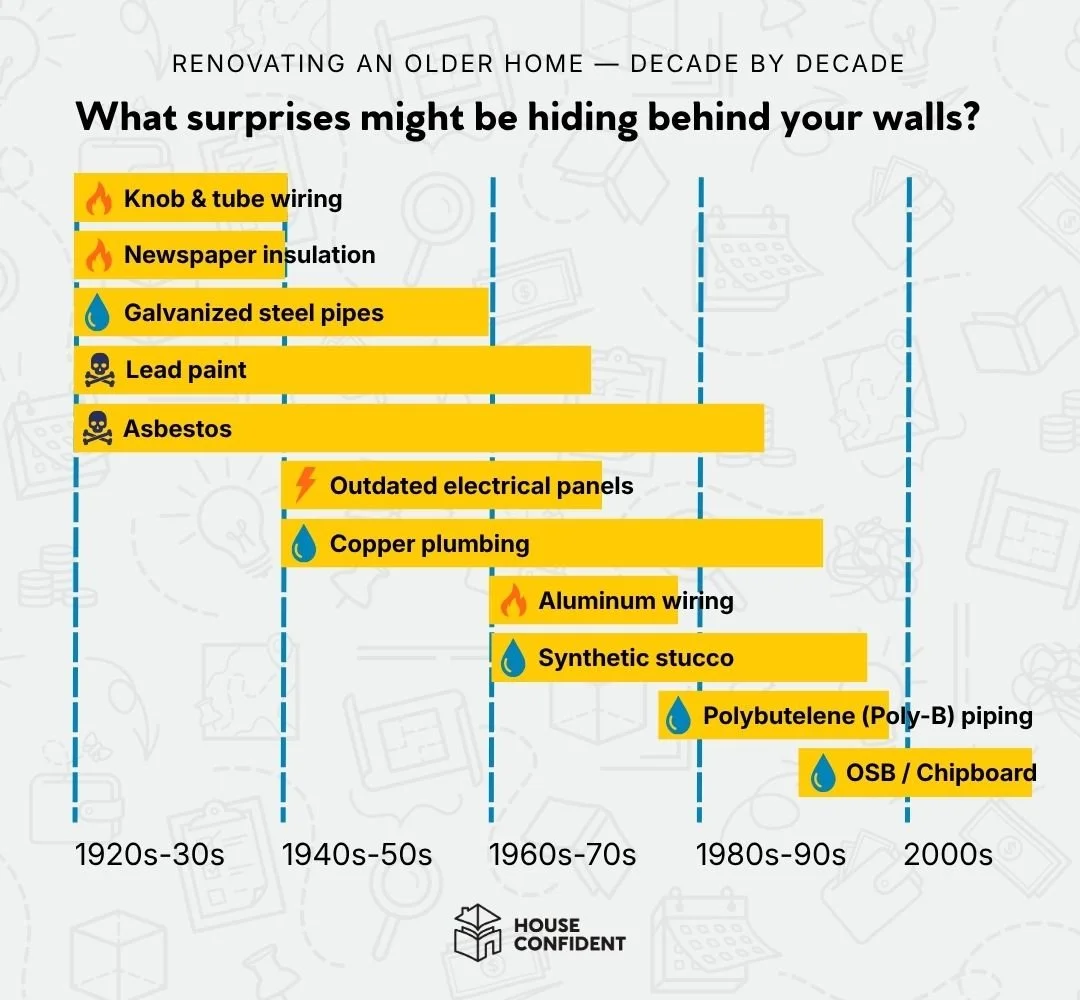
A decade-by-decade look at what an old house can hide behind its walls: knob and tube wiring, asbestos, copper pipes, Poly-B plumbing, and more.
1920s–30s
Homes built in this era have a lot of character, but their core systems were not designed to handle modern electrical loads or appliance demands — and a few of the materials from this period are now known to be major health hazards. If you’re opening up walls in a house from these decades, expect to do some major updating.
Knob and tube wiring: Common from the 1880s until around 1940, this type of wiring poses a massive electrical fire hazard and legally MUST be replaced once discovered.
Galvanized steel pipes: Used from the 1920s until 1960, these plumbing lines rust and corrode from the inside out, choking your water pressure.
Lead paint layers: Lead paint was used from this time period up until it was banned in the ‘70s because of its toxicity. It’s still present under newer coats of paint in a huge number of older homes.
Newspaper insulation: Builders commonly stuffed wall cavities with old newspapers, creating a major fire risk and zero thermal protection.
Asbestos: This hazardous material showed up from the 1920s all the way through to the mid-1980s, so it can turn up in almost any home built across those decades. It's commonly found in attic insulation, popcorn ceilings, floor tiles, adhesives, pipe wrapping, and old drywall compound. In my experience, if asbestos turns up in a Vancouver reno, the abatement usually runs around $40,000. It has to be sealed off and stripped out by a specialist crew with full hazmat suits, and that's slow, careful work.
1940s–50s
Post-war homes mark a time where synthetic, factory-made materials really started showing up in residential construction. While structural framing from this era is often rock solid, this is also the time when a lot of dangerous materials were commonly used.
Copper plumbing: Copper began replacing steel in this era and remained the go-to choice into the 1990s. Older copper lines eventually wear thin and develop tiny pinhole leaks that trigger hidden water damage.
Outdated electrical panels: Electrical systems in these houses frequently top out at 60 amps, which is nowhere near enough power for a modern home.
Asbestos: Still in use in these decades.
Lead paint: Still in use in these decades.
Galvanized steel pipes: Still in use in these decades.
1960s–70s
The building boom of the 1960s and 1970s came with huge shifts in engineering, but resource shortages led to some notoriously unreliable material choices. Renovating a house from this era means you’ll need to watch out for experimental products that don't necessarily hold up over time.
Aluminum wiring: Commonly substituted for copper from the mid-1960s to 1978 due to soaring copper prices, aluminum connections loosen over time and present a severe fire hazard.
Synthetic stucco systems: Also known as EIFS, these were installed from around 1960 into the mid-1990s. Early synthetic stucco installations created serious moisture trapping problems, especially for those of us on the rainy West Coast.
Early polybutylene piping: These pipes started appearing at the tail end of the 1970s. Also known as Poly-B, they degrade from the inside out when exposed to chlorinated water and can fail completely without warning.
Asbestos: Still in use in these decades.
Copper plumbing: Still in use in these decades.
Lead paint: In use until the ‘70s.
Outdated electrical panels: In use until the ‘70s.
1980s
By the 1980s, suburban housing developments were popping up all over the place. Widespread use of cheap plastics and new synthetic exterior walls mean your biggest renovation risks in an '80s house are plumbing failures and hidden water damage.
Polybutylene plastic (Poly-B) pipes: These fragile plastic lines were installed from 1978 until 1997. Commonly referred to as Poly-B, they degrade from the inside out when exposed to chlorinated water and can fail completely without warning — which makes them a major structural flooding risk.
Copper plumbing: Still in use in this decade.
Synthetic stucco systems: Still in use in this decade.
Asbestos: In use until the mid ‘80s.
1990s–2000s
Even relatively modern homes come with their own quirks. Watch out for issues that carry over from earlier decades, as well as the trade-offs that come with more modern materials we’re familiar with today.
Oriented strand board (OSB): Also known as chipboard, OSB started replacing traditional plywood for structural wall sheathing in the ‘90s. It performs fine when it stays dry but it doesn’t handle moisture exposure well and loses structural integrity quickly if exposed to an active leak.
Copper plumbing: In use until the early ‘90s.
Synthetic stucco systems: In use until the mid ‘90s.
Polybutylene plastic (Poly-B) pipes: In use until 1997.
Renovate with your eyes open
I don’t say this to scare you off renovating, but instead to help you walk into the process with your eyes wide open so you can protect your financial investment.
Before you finalize your renovation budget, find out exactly when your home was built. Then have a frank conversation with your contractor about what you might be inheriting from that era. It’s no insurance against surprises, but it’s a good place to start anticipating what you might find behind the walls.
Ready to start planning your renovation? Download the Home Building Checklist below to make sure you’ve got your bases covered!