Planning your kitchen renovation: 4 decisions that determine everything
It's week 3 of your kitchen reno. You're standing in a gutted space with exposed studs, and your contractor just told you the fridge you ordered won't fit. Your countertop guy can't template until the cabinets are in. And you're already $15K over budget with no end in sight.
Nightmare, right?
Unfortunately, this kind of thing happens all too often. I’ve had clients who spent their planning process on Pinterest inspiration and paint colors and assumed they could figure out the details as they go. By the time they realize they missed out on key decisions, they were mid-demo and there was no turning back.
So how do you avoid this?
There are 4 critical decisions that need to happen BEFORE you do anything else in your kitchen reno. Focus on nailing these down first, and you’ll find everything else becomes a whole lot easier.
The 4 critical kitchen reno planning decisions
Decision #1: Budget
Every home construction or renovation project should always, always start here. Why? Because budget is usually the main constraint on your project and will directly impact all of the other decisions we talk through in this article.
Your budget will directly inform:
How much you tackle (AKA your project scope) and how complex your renovation is
Who you hire to help, and how much they do for you
The materials and appliances you choose
Your timelines and how long things will take — particularly if you decide to work in phases
Ultimately, having your budget in place from the start will force you to work within realistic parameters from day one. It’ll keep you focused and help you make better decisions.
I’ve written an entire post about kitchen renovation budgets and what they should include. But for our purposes here, the Coles Notes version is:
Set your total budget number. What can you actually afford to spend?
Break things down into major line items. The top budget categories are typically appliances, cabinets and countertops, and flooring (in that order). But there are a lot of expenses that homeowners forget to plan for. Be thorough and don’t rush this part!
Make sure you have a contingency fund. This is a separate pot of cash that you set aside in addition to your renovation budget to allow for any surprises or emergencies that crop up along the way. 15% for a simple reno and 30% for a complex one is a good place to start (more on the different types of reno — and why you need different contingency funds — here).
Decision #2: Appliances
There are a few reasons to decide on your appliances as early as possible.
They’re one of the most expensive parts of any kitchen and will eat up a significant portion of your overall budget. Knowing what you’re planning to spend on appliances will make it easier to plan the rest of your budget — or where to cut back if the numbers aren’t adding up.
Appliances also dramatically affect your decisions about layout and space (see Decision #3 below). Things like dimensions, the direction doors swing, and what they require for electrical, plumbing, or ducting can all directly impact other parts of the overall design and building process. Read more about what you should know before you buy your appliances here.
Ordering your appliances early will likely give you more selection and the freedom to find a good price. It also removes the pressure to build your entire renovation timeline around when your appliances will arrive.
Decision #3: Layout
Knowing how much you want to change your kitchen layout is a key decision-making factor. There are two key things that will really affect this:
How much you move things around or open things up. The more you move things around, the more complicated, expensive, and time-consuming your project will be.
The appliances you choose. If your new appliances have different dimensions, doors, or electrical/plumbing requirements, they may impact things like traffic flow, cabinetry configuration, or behind-the-walls stuff like plumbing, ducting, or wiring.
To figure out how significant layout will be to your kitchen reno, get clear early on how you need your kitchen to function in your daily life. What parts of your kitchen do you love right now? What do you hate or wish you could change?
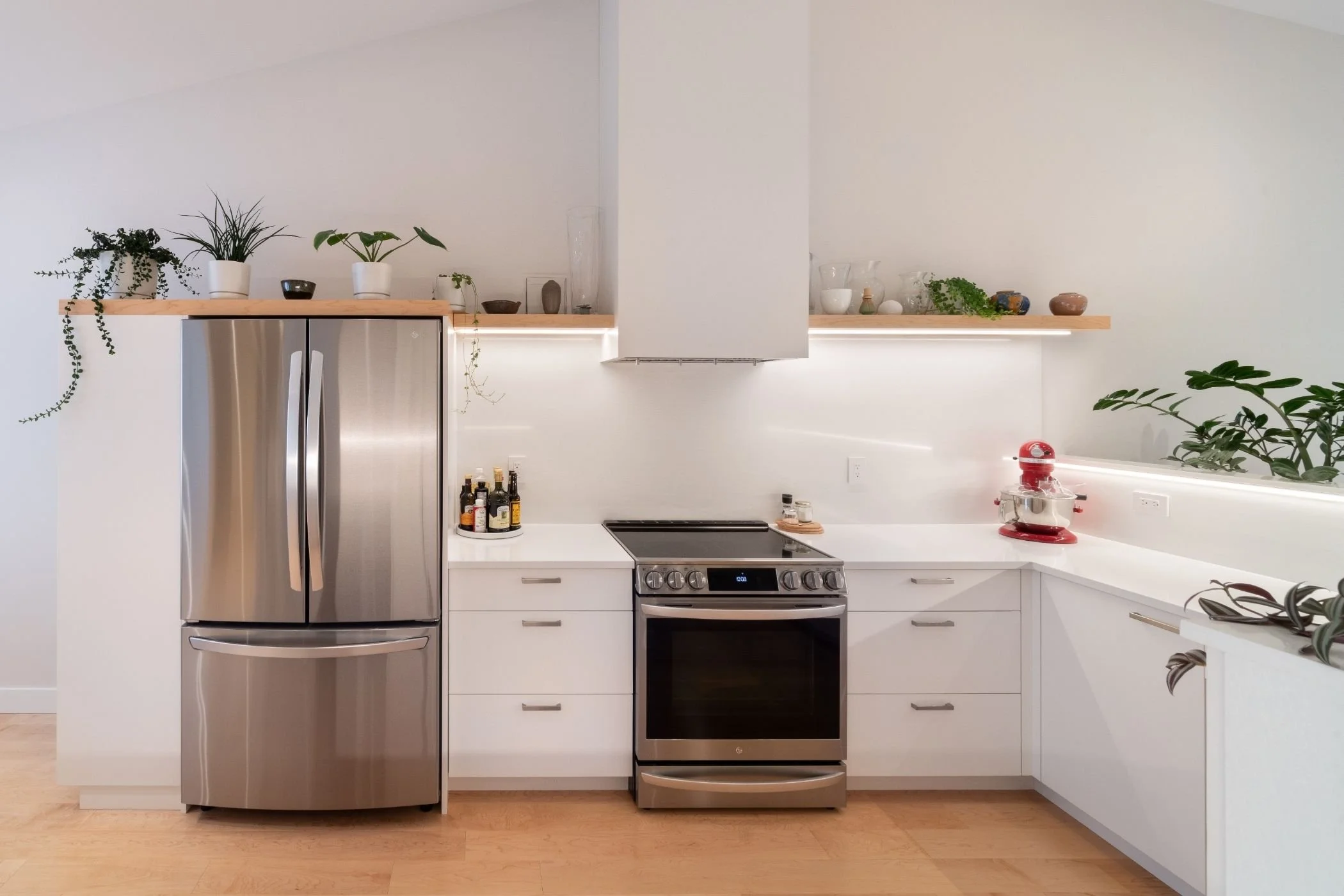
Thinking through the five main zones in your kitchen’s layout will help you figure this out. These are:
Cold storage (fridge and freezer)
Pantry storage (non-refrigerated items)
Food preparation
Cooking
Cleanup (sink & dishwasher)
Read my guide to space design and layout in your kitchen for more on what’s involved here.
Decision #4: Timeline
On pretty much every project, clients underestimate how long things will take… and not just by a little bit! The general rule of thumb I give my clients is to plan for your reno to take twice as long as you expect.
Setting a realistic timeline matters for a number of reasons.
It gives you longer lead times and a bigger availability window when you’re ordering appliances and materials
It allows you to plan for availability of your contractors and trades — including juggling multiple schedules at once
It gives you space to make calm, smart decisions vs. stressed, rushed ones
It builds in buffer for when surprises pop up or things go sideways
There’s an entire blog post on timelines and how long kitchen renovations really take here.
But I’ll add one extra piece of advice: Don’t start a reno in September if you want to be done by Christmas. This is one of the most common deadlines clients work towards, but even basic renovations take three months minimum to complete. If you know you want to cook Christmas dinner in your dream kitchen, start your reno in the summer.
What planning order should you follow?
I wish I could say you could work through these sequentially and tick them off the list one at a time. But these four decisions — budget, appliances, layout, and time — are interconnected. Tweak something in one area, and you’ll see an impact in another.
For example:
Lower your budget → the stove you want might be out of your price range
Decide to move your sink → your timelines get pushed out to accommodate the plumber and cabinetry changes
Switch from a fridge with French doors to a fridge with a single door → adjust your layout to allow counter space for easily loading and unloading food
It’s complicated!
Which means giving yourself enough time to figure out how everything works is critical.
As much as you possibly can, try to make all of your big decisions in these four areas BEFORE you start knocking down walls or taking down cabinets.
Giving yourself lots of time to plan and make these key decisions means that you can roll with the punches when things change — because it’s changing on paper rather than in a demo zone.
That said, you still need an order of operations to follow. So here’s what I recommend. This is the same process I follow with my kitchen clients.
Your kitchen renovation planning checklist
Before you swing a hammer, follow these steps.
Step 1: Create a preliminary budget
You can find the different kitchen renovation categories you should be budgeting for here. At this stage, you should be assigning numbers to each category and making sure you have a contingency fund in place.
Things will change, but this gives you a sense of what you’re working with (and what the limits are).
Step 2: Set a preliminary timeline
Get a sense of when you want to do the work. When do you want to start? When do you want to finish? Are there firm deadlines on either side of these timelines (i.e. you don’t want to start before school lets out, or you must be done by Christmas)?
As a reminder, plan for a minimum of three months. Here’s that kitchen renovation timeline article again if you want the full breakdown.
As with your budget, you’ll adjust this along the way, but you’ll need to have a realistic set of reference points to help with decision-making.
Step 3: Get clear on your must-haves and nice-to-haves
Knowing what you want and need from your space is key to making solid decisions. Take a look at this kitchen design article and this space design article for specific questions to be asking yourself around how you’ll use the space and what’s important to you.
Step 4: Narrow in on your appliances
Make a shortlist of the appliances you’ll buy. Pick a favourite, but have backups in mind too.
Keep in mind that if you’re upgrading the size of your appliances (bigger fridge, bigger stove) your layout will have to accommodate this.
Step 5: Make a shortlist of any fixtures, materials, and finishes you really want to incorporate
You don’t need to choose paint colours at this stage, but if you know you want a wall-mount faucet or pot-filler over the stove, make that list now. These kinds of things will help as you think about layout and how everything works together.
Step 6: Create your preliminary layout
With your preliminary budget, timeline, and appliances in mind, you can create your first layout and design drawings. Keep in mind the five zones you’ll want to plan for!
An extra word of advice here: Make sure to get 3D renderings as you work on your layout. This is non-negotiable in my opinion. They’re critical to helping you envision the space and catching wonky errors that don’t necessarily show up in a 2D drawing. This technology is becoming more and more common but in my experience a lot of designers and architects still don’t include them.
Step 7: Plan for your adjoining spaces
Kitchen renos always take more space than you think. Your work zone will spill over into adjacent rooms for various reasons:
Staging space for cabinet assembly
Opening up walls / floors / ceilings to access plumbing, electrical, HVAC
Access for moving large appliances, countertops, or pre-assembled cabinetry into your kitchen
Tracking dust, debris, and waste inside and outside
You’ll also need to consider how and where you’ll cook and eat during your renovation, and where you’ll store all the stuff that usually lives in your kitchen cabinets.
Make a plan for how you’ll accommodate these issues in the rest of your house!
Step 7: Refine, refine, refine
This is where things become a dance. Now that you have your appliances and layout in place, you can revisit your budget and timeline. If things are out of alignment, you’ll need to adjust… which will mean tweaking things.
Again, better to do this now while everything is on paper! Don’t be afraid to do multiple rounds of this. By nailing things down now, you’re saving yourself a ton of headache and money in the long run.
Step 8: Order your appliances and other materials
Once you have your layout locked down, appliances finalized, and you’re happy with how the budget and timeline are looking, it’s time to start ordering.
As much as possible, purchase your appliances and other materials (tile, flooring, fixtures, etc.) in advance and store them somewhere safe. This allows you to control your costs and buy at the price you intend. It also limits any issues around mid-project backorders and delays.
Step 9: Line up your trades
If you’re working with a general contractor, they’ll take care of this — but otherwise this is up to you. (More on how to hire good trades here.)
Do your best to have your trades confirmed and booked in advance. And if you can, build in buffer time between trades! Scheduling and coordinating trades is a huge reason for timeline delays in renovations, so giving yourself extra time means that if something goes wrong you don’t get a domino effect of delays.
Step 10: Do a final budget and timeline check
At this point, pretty much everything is booked and your plan is in place. Do a final check against your budget and timelines to make sure things are still on track. If you need to adjust, now is the time to do it.
Step 11: Start construction!
You’re ready to go! You can see a rough kitchen renovation schedule here to get a sense of how things will proceed. And remember to keep revisiting your budget and timeline as you go. These things are fluid and you’ll need to be flexible, but at this point all of your planning should start paying off.
Key takeaways
Most kitchen renovation stress comes from making the wrong decisions in the wrong order. Here's what I recommend when it comes to planning your kitchen renovation:
There are four main decisions you’ll need to make as you plan your kitchen renovation: budget, timeline, appliances, and layout.
These four decisions are interconnected, not sequential. Change your appliance size and your layout shifts. Adjust your timeline and your material options change. You can't make these decisions in isolation — they all affect each other.
Make these decisions BEFORE demo starts. Once the walls are open and cabinets are out, you're locked in. Changes mid-project cost more money, take more time, and create more stress. Do this work on paper, not in a gutted kitchen.
The time you invest in planning now saves you money and headache later. Spending a few months nailing down budget, appliances, layout, and timeline might feel slow. But it's infinitely better than scrambling to adjust under pressure in a demo zone.
Kitchen renovations are complicated — probably the most complicated kind of reno you can do in your home. But when you focus on planning the right things in the right way, you set yourself up for success. Get budget, appliances, layout, and timeline figured out before demo day, and you'll be ahead of 90% of homeowners who jump in unprepared.